
The report put India's 'stored' nuclear warheads at 172 in January this year while the number for Pakistan was 170.

Is North Korea really dismantling its nuclear programme? Rajaram Panda explains the many challenges to denuclearise the Korean Peninsula.

Prime Minister Manmohan Singh hopes that the United States will help India get the official status of a nuclear weapons state, given its impeccable record in the field of non-proliferation.

'It is typical of China's strategic deception of making virtue out of necessity,' observes Rup Narayan Das.

'Government officials use Gmail and ordinary phones without basic security consciousness.' 'Interoperability, especially in joint exercises with countries like the US, worries me.' 'It often means we open our systems to them, but they don't reciprocate.' 'They could have kill switches in their systems and might even be able to affect ours.'

New Delhi might have loudly welcomed an age of multipolarity, hedging and strategic autonomy. But it seems the winner in that game is Islamabad, not us, points out Mihir S Sharma.

The Israel Defence Forces (IDF) intensified its campaign in Lebanon with targeted airstrikes on Hezbollah strongholds in Beirut, hitting key weapons depots and terror infrastructure overnight, according to a report by Times of Israel.

He then went on to say that, however, he won't get a Nobel Peace Prize for any of his efforts.
India today welcomed the renewed global push for achieving a world free of atomic weapons but underlined that the international nuclear order cannot be "discriminatory".

Indian policymakers must incorporate in their nuclear doctrine a realistic response to tactical nuclear warheads, says Ajai Shukla.
Pakistan is producing more bomb grade uranium for new generation of nuclear weapons, even while being racked by insurgency, raising questions on Capitol Hill whether billions of dollars in proposed US military aid could be diverted to its nuclear programme.
Pakistan has approximately 60 nuclear warheads in its arsenal, although the figure could be higher, according to a report by the Congressional Research Service.The report states that Pakistan "continues to produce fissile material for weapons and appears to be augmenting its weapons production facilities, as well as deploying additional delivery vehicles -- steps that will enable both quantitative and qualitative improvements in Islamabad's nuclear arsenal."
Pakistan has the world's fastest-growing nuclear stockpile and it could achieve 150-200 warheads in a decade despite the political instability in the country, two top American atomic experts have said.

AQ Khan, a controversial scientist known as the father of Pakistan's clandestine nuclear programme, passed away here on Sunday after a brief illness. He was 85.

'The heat shield technology for re-entry vehicles was first mastered in DRDO for the Agni missile.' 'This is why the Americans were so opposed to Agni in the 1980s, unlike other missiles -- it was a re-entry vehicle.'

With this India joins the select group of countries which have a nuclear triad -- capable of delivering nuclear weapons by aircraft, ballistic missiles and submarine launched missiles.
The spectre of Pakistan's nuclear weapons falling into the hands of terrorist organisations has once again come to the fore. Western commentators are calling for plans to secure or destroy the nuclear warheads in the event of a meltdown. It would be in India's interest to provide the maximum possible assistance for such a move, says Brigadier Gurmeet Kanwal (retd)

Pyongyang on Sunday claimed it has successfully tested a hydrogen bomb meant to be loaded onto an intercontinental ballistic missile. It was Pyongyang's sixth, and most powerful, nuclear test, which was set to raise tension in the region.

Aziz said Pakistan is committed not to transfer nuclear weapons to other states or assist others to acquire nuclear weapons and consistently supported the goal of a nuclear-weapons-free world.
As of today, there are nine countries generally recognised to own nuclear weapons, with Iran actively seeking to join this group.

While advancements in biotechnology hold immense promise for health and innovation, they also come with significant risks if misused.

India is at war with terrorists and will bring justice to victims of the Pahalgam attack by holding the perpetrators accountable, Indian Ambassador to the US Vinay Kwatra has said. He underscored that India launched 'Operation Sindoor' on May 7, striking terror factories at nine locations in Pakistan and Pakistan-occupied Kashmir in retaliation for the Pahalgam terror attack that killed 26 civilians. Kwatra also criticized Pakistan for its continued support of terrorism and said that the world should be concerned about this.
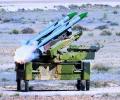
'When one air force (India's) hits the other's airbases with impunity and that air force (Pakistan's) is not able to respond, then the air force, which has put the other's airbases out of commission, has won.'
The move was apparently aimed at Israel, which neither admits nor denies possessing nuclear weapons but is perceived by the countries in the region to have such arms.
Amid growing concerns of nuclear weapons falling into the hands of terrorists, Prime Minister Manmohan Singh will join leaders of 42 other countries in Washington on April 12 to discuss ways to strengthen the global initiatives to prevent such a scenario.The two-day Nuclear Security Summit, an initiative of US President Barack Obama, will focus on dangers posed by clandestine proliferation and illicit trafficking of nuclear material.
Among Pakistan's neighbouring countries, India will be particularly vulnerable if Islamist terrorists and their Al Qaeda and Taliban brothers ever lay their hands on Pakistan's nuclear warheads as it is one of the nations that the Al Qaeda has named as an enemy. Being a contiguous land neighbour, it is also easier to target even if sophisticated delivery systems like ballistic missiles are not available
In his message on the occasion of 'International Day Against Nuclear Tests', UN Secretary General Ban Ki-moon said "we urgently need new progress in achieving a world free of both nuclear tests and nuclear weapons," which are increasingly being viewed as "dangerous relics of the Cold War" and are "long overdue for permanent retirement".

Amid growing global concern over safety of Pakistan's nuclear arsenals, India today said battlefield atomic weapons of that country were at the heart of such apprehensions.

'You don't need massive industry or huge energy resources.' 'You could start with just 3 or 4 people in a coffee shop and invent the world.'

'If Indian armed forces entered Pakistan and succeeded in inflicting major damage on the Pakistani army and occupied territory in the Pakistani heartland, there is reason to think the Pakistani military would use some nuclear weapons against the incoming Indian forces to compel India to stop.'

"We know that Pakistan matters not just because it is the location for the Afghanistan Taliban leadership; it is also important in its own right. It's the base for Al Qaeda, it is a nuclear weapons state with the long-term risk of radicalisation," Miliband said in his testimony before the Senate Foreign Relations Committee, which had convened a special hearing on Afghanistan and Pakistan.
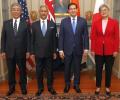
The Quad grouping has called for bringing the perpetrators, organisers and financiers of the Pahalgam terror attack to justice without any delay and urged UN member nations to extend cooperation for it.

Russian President Vladimir Putin on Wednesday monitored drills of the country's strategic nuclear forces involving multiple practice launches of ballistic and cruise missiles, the Kremlin said.
United States President Barack Obama on Tuesday warned that the threat of nuclear weapons remains a challenge as there are still "too many bad actors in search of these dangerous materials", asserting that the world's security depends on the actions that the global community takes.

A leading US daily describing nuclear-armed Pakistan as "unquestionably the biggest concern" to stability in South Asia.
The United States Air Force is testing 'weapons of tomorrow' including space weapons and an experimental microsatellite with the capability to disrupt other nations' military satellites.
Even as the Obama administration has started pushing for the ambitious goal of complete elimination of nuclear weapons, United States' Secretary of State Hillary Clinton on Wednesday said the US would maintain its nuclear deterrence.
Pakistan has started construction of its fourth nuclear reactor at Khushab in Punjab province, signalling its ambitious effort to modernise and expand the nuclear arsenal.
Pakistan's nuclear weapons programme is considered to be among the fastest growing in the world by Stockholm-based International Peace Research Institute, with the estimates of Islamabad possessing 90-110 nuclear warheads.
